Not a prompt pack. A governed delivery system.
Why governance
A deterministic plane that gates the probabilistic one
LLMs are fast and fallible.
{ai} engineering puts a deterministic layer underneath them — hooks, gates, a hash-chained audit log, and a spec-lifecycle state machine — so creative work stays probabilistic while everything that reaches a merge is checked, owned, and reproducible.
The judgment is yours; the guarantees are the framework's.
Held to its own gates — checked in public:




Everything below is how that holds — the flow, the enforcement, the toolkit.
The governed flow
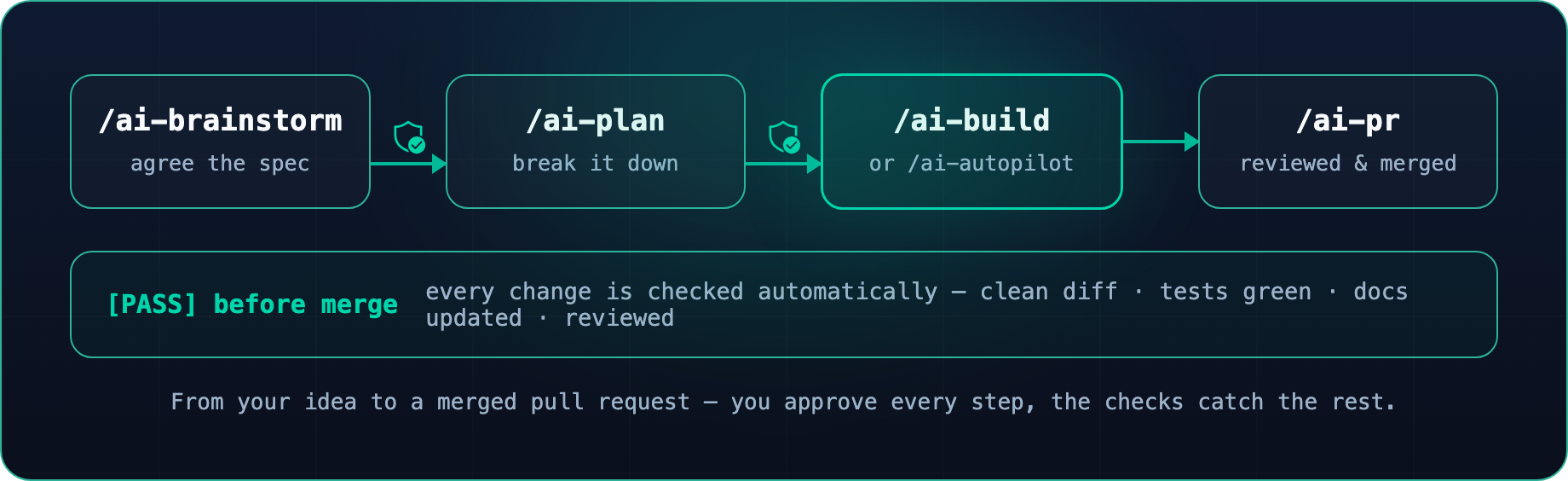
One chain. Intent to merge, gated at every step.
You drive the intent and approve each handoff. Deterministic gates block the rest — no secret, broken doc, or untested change reaches a merge.
One command in. A governed session out.
Press play: a real session installs the CLI, clears ai-eng doctorwith a [PASS], then runs the governed flow end to end — gates and all.
Governance that is enforced, not suggested.
Enforced by gates, not honoured by convention — the rules hold whether or not anyone is watching the PR.
What you approved is what shipped
A brainstorm gate and a spec state-machine keep every change anchored to the spec you approved — so spec and code never drift apart.
Every tool call is screened first
A deterministic guard checks every edit, write, and shell command — and stops the risky ones before they run.
Every bypass has an owner and an expiry
No # noqa, no @ts-ignore. Each suppression is refactored or formally risk-accepted with a severity-based TTL.
An audit trail you own
Every AI action appends to a hash-chained log you can verify offline. No telemetry by default.
Beyond governance
Built to ship the whole project, not just gate it.
For regulated teams, a solo developer, or a company whose agents ship code themselves — the same gates, entirely on your machine. No control plane, no lock-in.
Security-first — proven on itself
The framework builds itself under its own gates.
- dogfooded gates
- SonarCloud gate
- Snyk
- gitleaks
- semgrep
- SBOM
- SHA-pinned
- signed provenance
Context-efficient
- 16 KB output offload
- top-5 skill loading
- isolated subagents
- hot-path cache
Built for engineering
- simplify
- explain
- onboard
- debug
- review
- verify
Beyond code
- design
- slides
- visual
- animation
- media
- prose
Works where you work
- 6 IDE surfaces
- MCP-native
- GitHub
- Azure DevOps
Yours to extend
- composable skills
- Engram memory (optional)
- no control plane
- no lock-in
The toolkit
Fifty-four skills, nine agents, one flow.
Every capability is a /ai- command on an isolated agent context. Learn it once — it travels with the repo, identical on every surface.
- 54skills
- 9agents
- 6surfaces
- 1governed flow
Plan & build
brainstorm · plan · build · autopilot
Ship safely
review · verify · test · security
Design & docs
design · visual · slides · docs
Research & learn
research · explore · explain · note
Same flow, every surface
- Claude Code
- GitHub Copilot
- Codex
- Antigravity
- OpenCode
- Cursor
Get started
Up and running in four steps.
Two in your terminal, two in your editor — every step shows you exactly where you are, so nothing runs in the wrong place.
Install the CLI
$ uv tool install ai-engineeringPrefer pipx or pip? Both work too.
Add governance to your project
$ cd your-project
$ ai-eng install .
$ ai-eng doctor
  [PASS] hooks · mirrors · manifest · tools
Governance is now versioned local files in your repo.
Open your editor and start a session
› /ai-start
  [ready] context loaded · gates armed · audit live
Ease in — start observe-only and switch gates on as they earn it.
Ship through the governed chain
› /ai-brainstorm → /ai-plan → /ai-build → /ai-prYou drive the intent; deterministic gates catch the rest before merge.
Install once. Approve each step. Ship governed.
It is yours — versioned local files, no hosted control plane, no lock-in. ai-eng update to upgrade; delete the directory to leave. That is the whole exit cost.